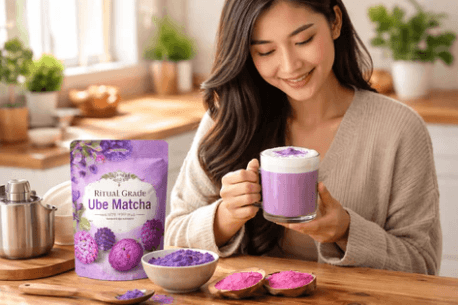
Vivid purple or bright green, creamy sweetness or grassy depth ube and matcha often sit side by side in cafés and on social feeds, yet they come from entirely different worlds. Many people in Australia see both powders in lattes, desserts or smoothie bowls and assume they play similar roles. The truth is more nuanced. One comes from a tropical root vegetable traditionally used in Filipino cooking, the other from finely ground Japanese green tea leaves cultivated with meticulous care. Their flavour profile, nutritional composition, caffeine levels and culinary versatility vary in meaningful ways. If you are weighing up which one suits your taste, your lifestyle or your pantry, understanding these distinctions makes all the difference. Let’s break down what sets ube and matcha apart so you can choose with confidence rather than curiosity alone.
Origin and botanical background
Ube and matcha begin their journey in entirely separate botanical families. Ube refers to Dioscorea alata, a purple yam widely grown in the Philippines and across parts of Southeast Asia. It is a starchy tuber, similar in structure to sweet potato, yet with a more delicate sweetness and a striking violet hue that feels almost theatrical on the plate. The colour comes from natural plant pigments known as anthocyanins, which also appear in blueberries and purple cabbage. In Filipino culture, ube has long been used in festive desserts such as halaya, cakes and ice cream. Its flavour is often described as mellow, slightly nutty, gently vanilla-like, with an earthy undertone that rounds out its sweetness.
Matcha, by contrast, is made from the leaves of Camellia sinensis, the same plant used for green tea. What makes matcha unique is its cultivation method. Tea bushes are shaded several weeks before harvest, increasing chlorophyll and amino acid levels. The leaves are then steamed, dried and stone-ground into a fine powder. When you drink matcha, you consume the entire leaf rather than just an infusion. That process explains its vivid green colour and concentrated composition.
From a structural standpoint, one is a root vegetable rich in complex carbohydrates, the other a tea leaf rich in polyphenols. They may share shelf space in modern cafés, yet botanically they stand at opposite ends of the plant kingdom. Understanding this foundation clarifies why their nutritional behaviour and sensory profile differ so noticeably.
Flavour profile and texture differences
Taste is where most people first notice the contrast. Ube has a naturally sweet, creamy flavour with hints of vanilla and toasted nuts. It feels comforting, almost nostalgic, like a dessert base waiting to be dressed with coconut milk or condensed milk. Its texture, when cooked and mashed or blended into powder, becomes smooth and velvety. In drinks, it produces a thick, milkshake-like body that pairs well with dairy or plant-based milks.
Matcha sits on the other end of the spectrum. Its flavour is vegetal, slightly grassy, sometimes described as umami-rich. High-quality ceremonial matcha offers a smooth, subtly sweet finish, while culinary-grade matcha can lean towards bitterness. The texture in a properly whisked matcha latte is light yet creamy, though it never delivers the dense starchiness that ube provides.
In simple terms, ube behaves like a dessert ingredient, while matcha behaves like a beverage base with culinary crossover potential. One wraps the palate in softness; the other stimulates it with brightness and gentle astringency. Choosing between them often comes down to whether you crave sweetness without added sugar or prefer a layered, slightly bitter complexity.
Nutritional composition and caffeine content
When evaluating ube vs matcha nutrition, the differences become practical. Ube is primarily composed of carbohydrates, especially complex starches. It provides dietary fibre, vitamin C, small amounts of potassium and antioxidant compounds such as anthocyanins. It does not contain caffeine. Its energy release is steady, tied to carbohydrate digestion, which makes it suitable for those avoiding stimulants.
Matcha delivers a very different nutritional profile. Because you ingest the entire powdered leaf, you obtain concentrated catechins, particularly EGCG, along with L-theanine and moderate caffeine levels. A typical serving of matcha may contain between 60 to 70 milligrams of caffeine, depending on preparation strength. L-theanine interacts with caffeine in a way many people describe as producing calm alertness rather than jittery stimulation. To visualise the contrast clearly:
- Ube
- Matcha
- Anthocyanins
- Catechins
- Caffeine
- Complex carbohydrates
If you are sensitive to caffeine or seeking an evening treat, ube makes sense. If you want a morning lift with antioxidant density, matcha fits that role more naturally. The two serve different physiological purposes, which explains why they are rarely interchangeable from a nutritional standpoint.
See also: How to Find a Life Partner Online: Tips for Muslim Singles
Culinary uses and versatility
In Australian cafés and home kitchens, both ingredients have found creative expression. Ube appears in lattes, cheesecakes, doughnuts and smoothie bowls. Its vibrant purple colour acts almost like edible theatre, drawing attention before the first sip. Many local consumers exploring ube products discover that quality sourcing matters, especially when looking for authentic flavour rather than artificially flavoured powders.
Matcha thrives in beverages such as traditional whisked tea, iced lattes and protein smoothies. It also integrates into baked goods, from muffins to pancakes, adding a subtle bitterness that balances sweetness. In savoury contexts, matcha can even be used in sauces or spice blends, though that remains less common in mainstream Australian cooking.
The practical difference lies in how they behave under heat and blending. Ube thickens mixtures, contributing body and natural sweetness. Matcha dissolves and disperses, lending colour and flavour without altering texture dramatically. In recipe development, that distinction affects everything from baking ratios to beverage foam stability.
Which one should you choose?
The decision between ube and matcha depends less on trend and more on personal intent. If you are seeking a caffeine-free option with a gentle sweetness and striking colour, ube aligns with that goal. It suits dessert lovers, families and those wanting a comforting flavour without added stimulants. If your priority is focus, antioxidant density and a traditional tea ritual adapted to modern life, matcha offers that pathway.
Think of ube as a warm sunset in a glass soothing, indulgent, quietly sweet. Matcha feels more like early morning light, crisp and energising. Both can fit into a balanced diet. They simply answer different needs.
Final thoughts on ube and matcha
Ube and matcha may share visual appeal in contemporary food culture, yet their differences run deep. One is a vibrant purple yam rooted in tropical tradition, the other a finely milled green tea shaped by centuries of craftsmanship. Their flavour, nutritional impact and culinary behaviour set them apart in clear ways. The right choice comes down to what you want from your cup or plate. Are you chasing comfort without caffeine, or clarity with a gentle lift? Once you understand what each ingredient brings to the table, the decision becomes straightforward and far more satisfying.